
Everything I Learned About Power, I learned at Home
How multicultural families unknowingly pass down hierarchy, and how we begin to change it

Earlier this month, I wrote that if we don’t address the power dynamics at play in multicultural families, we will inevitably replicate the systems of oppression we live within inside our own homes.
In last week’s At the Table interview, linguist Malwina Gudowska named this plainly: “If you don’t account for the emotional or the political, something will inevitably come to a head.”
If that still feels abstract, today’s Invisible Script grounds it in a story from my own childhood. Let’s get into it.

By now, you’ve probably seen several explanations of Bad Bunny’s masterful use of symbology throughout his Super Tazón performance. I was rapt from the opening shot of the field of sugar cane, but it was seeing Benito wake the child sleeping on chairs at the wedding that convinced me that this show was really for us, for me. The gesture passed so quickly that it could easily go unnoticed unless you’ve been that kid. Then it holds the world.
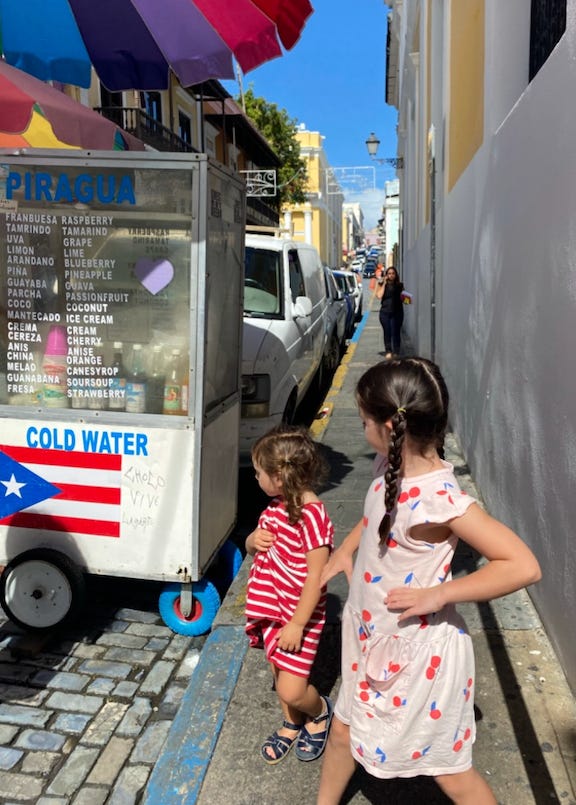
I kept my kids up late to watch the show. They watched with mouths agape, smiling, singing. They danced and jumped. They recognized the Puerto Rican flag and then, the Chilean flag. Their flags. We cheered for America–all of it–and when the show ended we hugged before I scooted them off to bed.
Laying next to my littlest while she fell asleep, I was overwhelmed with gratitude, but also something else. I found myself grappling with the grief of recognizing a rich part of my own story that has not always been welcome–even in my own home.
I grew up in a home where the melody and rhythm of my mother’s Boricua dialect was noticeably absent.
This was explained as a choice made for the sake of the theater. My parents were actors; their Spanish needed to be accessible. My father’s Chilean accent had also been softened, supposedly for the same reason but likely also from years of living in exile among Latin Americans of varied nationalities.
But it wasn’t just onstage that my mother’s Spanish changed, and even as a child I was aware that if there was a choice between the two, we only used the Chilean word.
Porotos, not habichuelas.
Palta, not aguacate.
Choclo, not maiz.
Whether it was stated explicitly or not, I understood that Chilean culture was more highly valued. I also knew that our Chilean family was descended from France. From there, I connected the dots.
Long before the world taught me that Puerto Rican culture, Caribbean culture, island culture, Indigenous culture, African culture, and Black culture were inferior to white culture, I learned it at home.
The Invisible Script
Our homes are reflections of our broader society. Boricua culture has been stigmatized for so long that my parents likely weren’t even aware that I was learning to devalue it from choices that they didn’t give much thought to.
So much of parenting happens moment to moment that we often just go with our gut.
The problem is, those instincts often originate in the systems we were raised inside, not the values we consciously want to pass on.
There was a lesson underneath the way my family spoke. I learned, quietly and early, that some parts of who I was were easier to hold than others.
Some cultures are easier to claim than others.
Some identities deserve to be centered.
Some parts of ourselves are “too much.”

Why This Matters
Multiculturalism isn’t just about adding on languages, food, or holidays. It’s about whose culture gets normalized and valued, and whose gets disappeared. When that happens inside our families, it can shape how we see ourselves and each other for years.
It is, of course, harmful for the person whose culture is sidelined. It is also harmful for our kids because they contain both cultures, histories, and identities.
Our homes are reflections, yes, but they are also forces in shaping society. Once we notice the invisible scripts we are passing on, we can work to shift them.
I am Chilena but I am also Boricua. Now that I’m grown, I refuse to choose between the two.
Try This
One of my favorite things about the halftime show was that there were people of all ages in it, just like at real Puerto Rican parties. This month, our conversation prompt is intergenerational.
Invite your family (kids too!) to imagine your own halftime show. Feel free to use the following questions as a guide:
If you were headlining the halftime show, what part of our culture would you put on stage, even if some people didn’t understand it?
What songs would make it on the playlist and why?
Bad Bunny waved flags from all over the Americas. If you could carry one symbol onstage with you, what would it be and why?
Who would you bring onstage with you that might otherwise be excluded?
What would you give them to welcome them?
Let me know your own answers below! Especially the songs. We could all use some playlist inspo.
Hasta Pronto,
Melina

What I’m Reading & Listening to This Month
On Repentance and Repair by Danya Ruttenberg - started reading this book on Priya Parker’s recommendation (see below) and it is all I want to talk about.
Priya Parker on the Ezra Klein Show - I’d taken a break from this podcast but tuned in for this episode. If you need encouragement to start or return to hosting, listen in.
The Moment with Paola and Jorge Ramos - The whole show, but most recently this episode on medical aid in dying and how culture and policy interact. Personally, I love hearing Paola and her dad move in and out of Spanish.
How to Stop Intergenerational Trauma in Immigrant Families - this interview by Elissa Strauss of Alicia Lieberman and Vilma Reyes is deeply inspiring
Liana Finck’s cartoons - She always nails it. This one in particular really got me. Apologies to Mike and to our contractor for having intimated that with the right tools I, too, could plumb a bathroom.
Ay, Melina. Your words touched my heart. Over the last three decades in the mainland, I have seen how multicultural families have found ways to preserve their heritage culture and keep them alive. One reason why I wrote my book, Arroz con Pollo and Apple Pie:Raising Bicultural Children, to help parents find a balance and the intention to pass down their culture. Thanks for sharing your experience! Maritere R. Bellas